

When temperatures in the Conejo Valley and Simi Valley climb past 100 °F, the last thing you want is an air conditioner that stops working. Southern California summers are intense, and a failing AC system can turn your home into an oven within hours. The good news is that many common air conditioning issues have straightforward fixes you can try before calling a professional. In this guide, the NATE-Certified technicians at Air Force Air Conditioning & Heating walk you through the most frequent summer AC problems, DIY troubleshooting steps, and when it is time to bring in expert help.
Common Air Conditioning Problems in Summer
A central air conditioning system is a network of components that work together to remove heat and humidity from indoor air. When any single part fails, the entire system can underperform or shut down. Here are the issues our technicians see most often during peak summer months in Thousand Oaks, Simi Valley, and Westlake Village.
| Problem | Likely Cause | DIY Fix? | Pro Needed? |
|---|---|---|---|
| AC blowing warm air | Dirty filter, low refrigerant, compressor failure | Check filter | Yes, if refrigerant |
| Unit won't turn on | Tripped breaker, faulty thermostat, blown fuse | Reset breaker | Yes, if electrical |
| Short cycling | Oversized unit, frozen coil, dirty condenser | Clean condenser | Yes, if coil frozen |
| Weak airflow | Clogged filter, blocked vents, duct leaks | Replace filter | Yes, if duct issue |
| Strange noises | Loose parts, failing motor, debris in unit | Remove debris | Yes, if motor |
| Water leaking | Clogged drain line, frozen evaporator coil | Clear drain line | Yes, if coil frozen |
DIY Troubleshooting Steps You Can Try Right Now
Before you schedule a service call, run through these quick checks. They can resolve roughly 30% of summer AC complaints without any tools or experience.
Step 1: Check Your Thermostat
Make sure the thermostat is set to "Cool" and the fan is on "Auto." A thermostat is the control device that tells your HVAC system when and how to operate. If the display is blank, replace the batteries. Sometimes a family member accidentally switches the mode to "Heat" or "Off."
Step 2: Inspect the Air Filter
A clogged air filter is the single most common reason an AC system underperforms in summer. According to the U.S. Department of Energy, replacing a dirty filter can lower your AC's energy consumption by 5% to 15%. Pull the filter out and hold it up to a light source. If you cannot see light through it, replace it immediately.
Step 3: Reset the Circuit Breaker
Head to your electrical panel and look for a tripped breaker labeled "AC" or "HVAC." Flip it fully off, wait 30 seconds, and flip it back on. If it trips again right away, stop and call a licensed technician to inspect for emergency AC repair.
Thermostat Issues That Mimic AC Failure
A surprising number of "broken AC" calls turn out to be thermostat problems. A programmable thermostat is an electronic device that adjusts heating and cooling schedules automatically based on preset times. If yours is more than 10 years old, the internal sensor may read temperatures inaccurately, causing the system to cycle on and off at the wrong times.
Try moving the set temperature 5 degrees below the current room temperature. If the system kicks on, the thermostat is likely the issue. Upgrading to a Wi-Fi-enabled smart thermostat can improve comfort and cut energy bills by up to 10%, according to ENERGY STAR.
Airflow Problems: Filters, Vents, and Ductwork
Restricted airflow forces your AC to work harder, raises energy costs, and can lead to frozen evaporator coils. Walk through every room and make sure all supply and return vents are fully open and unblocked by furniture, curtains, or rugs.
If airflow is still weak after replacing the filter and opening vents, the issue is likely in your ductwork. Leaky or disconnected ducts can waste 20% to 30% of conditioned air, per the U.S. Department of Energy. Our team offers professional duct cleaning and inspection services to identify and seal those leaks.
Refrigerant Leaks and Electrical Failures
If your AC is blowing air but it never gets cold, the refrigerant level may be low. Refrigerant is the chemical compound that absorbs heat from indoor air and releases it outside. Unlike a consumable fuel, refrigerant circulates in a closed loop. A low level always means there is a leak somewhere in the system.
Refrigerant handling requires EPA Section 608 certification, so this is never a DIY job. Signs of a leak include hissing sounds near the indoor unit, ice buildup on refrigerant lines, and higher-than-normal electricity bills. If you notice any of these, schedule a professional AC and heating repair service as soon as possible.
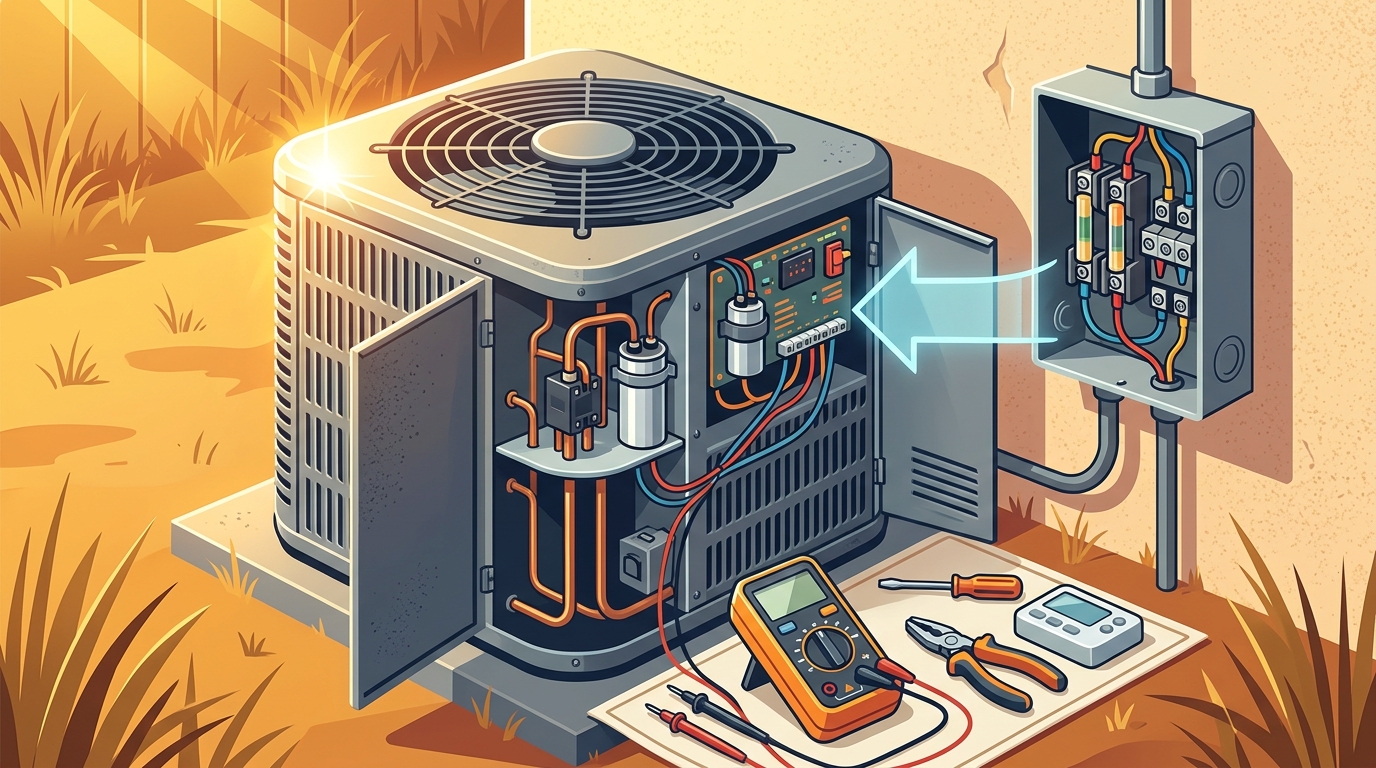
Electrical problems such as a failed capacitor, a burned-out contactor, or corroded wiring can also prevent your AC from operating. These components carry high voltage and should only be handled by trained professionals.
When to Call a Professional HVAC Technician
Some situations call for immediate professional attention. Contact a licensed HVAC company if you experience any of the following:
- The circuit breaker trips repeatedly after resetting.
- You smell burning or unusual chemical odors from the unit.
- Ice has formed on the refrigerant lines or evaporator coil.
- The outdoor compressor is running but the indoor fan is not.
- Your AC has not been serviced in more than 12 months.
Air Force Air Conditioning & Heating offers emergency AC repair in Thousand Oaks and surrounding areas with same-day availability during summer months. Our NATE-Certified technicians diagnose the problem on-site and provide transparent, upfront pricing before any work begins.
Preventive Maintenance to Avoid Future Breakdowns
The best way to solve air conditioning issues on a hot day is to prevent them from happening in the first place. The Air Conditioning Contractors of America (ACCA) recommends professional maintenance at least once per year, ideally in spring before peak cooling season.
A proper tune-up includes cleaning the condenser coils, checking refrigerant levels, tightening electrical connections, lubricating moving parts, and testing system controls. Our maintenance and tune-up programs are designed to catch small problems before they become expensive repairs.
Between professional visits, homeowners should replace the air filter every 30 to 90 days, keep the area around the outdoor unit clear of debris, and verify thermostat settings seasonally.
Key Takeaways
- A dirty air filter is the most common and easiest-to-fix cause of poor AC performance in summer.
- Always check the thermostat settings and circuit breaker before assuming a major breakdown.
- Low refrigerant always indicates a leak and requires a certified technician to repair.
- Leaky ductwork can waste up to 30% of your cooled air, driving up energy bills significantly.
- Same-day emergency AC repair is available from Air Force Air Conditioning & Heating across Conejo Valley, Simi Valley, and Thousand Oaks.
- Annual preventive maintenance reduces the risk of mid-summer breakdowns by catching wear early.
- Upgrading to a smart thermostat can improve efficiency and eliminate many thermostat-related cooling complaints.
Frequently Asked Questions
Why is my AC running but not cooling the house?
The most common causes are a dirty air filter, low refrigerant, or a malfunctioning compressor. Start by replacing the filter. If the problem continues, you likely need professional diagnosis from a qualified AC repair technician.
How often should I replace my AC air filter in summer?
During heavy use in Southern California summers, replace standard 1-inch filters every 30 days. Thicker 4-inch or 5-inch media filters can last up to 90 days. Homes with pets or allergy sufferers should change filters more frequently.
Is it safe to keep running my AC if it is making strange noises?
No. Grinding, squealing, or banging sounds typically indicate a failing motor, loose component, or debris caught in the blower. Turn off the system and call for professional repair to prevent further damage.
Can I recharge the refrigerant in my AC myself?
No. Handling refrigerant requires EPA Section 608 certification. Attempting a DIY recharge can damage the system and is illegal without proper credentials. A licensed technician can locate the leak, repair it, and recharge the system safely.
How much does emergency AC repair cost in Conejo Valley?
Costs vary depending on the problem. Simple fixes like a capacitor replacement may range from $150 to $350, while compressor repairs can exceed $1,000. Air Force Air Conditioning & Heating provides upfront pricing so you know the cost before work begins.
What temperature should I set my thermostat to on a hot day?
The U.S. Department of Energy recommends 78 °F when you are home. Each degree below 78 °F increases energy consumption by approximately 3%. Using ceiling fans can make 78 °F feel several degrees cooler without additional AC load.
When should I replace my AC instead of repairing it?
Consider replacement if your system is over 10 to 15 years old, requires frequent repairs, uses R-22 refrigerant (phased out in 2020), or has a SEER rating below 14. Our team can help you evaluate your options through a new AC installation consultation.
Stay Cool This Summer: Schedule Your AC Service Today
Do not wait until the next heat wave to discover your AC is not up to the task. Whether you need a quick repair, a full system tune-up, or a brand-new installation, the NATE-Certified team at Air Force Air Conditioning & Heating is ready to help homeowners across Thousand Oaks, Simi Valley, Westlake Village, and all of Ventura County. Contact us today to schedule your appointment and enjoy reliable comfort all summer long.