
When temperatures in Conejo Valley, Simi Valley, or Thousand Oaks climb past 100 degrees, the last thing you want is an air conditioner that stops working. Summer heat puts enormous strain on HVAC systems, and even small underlying problems can escalate into full breakdowns during peak demand. The good news is that many common AC issues have straightforward fixes you can try before calling a professional. In this guide, the NATE-Certified technicians at Air Force Air Conditioning & Heating walk you through the most frequent summer AC problems, what causes them, and exactly when to call for expert help.
Why Your AC Fails on the Hottest Days
Extreme heat forces your air conditioning system to run nearly nonstop. This extra strain exposes any underlying weaknesses in components like compressors, refrigerant lines, and electrical connections. According to the U.S. Department of Energy, on hot days a tripped high-pressure limit switch may stop the compressor entirely.
Clogged air filters and dirty condenser coils reduce airflow and heat exchange efficiency, making it harder for your AC to keep up. Southern California homeowners in areas like Thousand Oaks and Simi Valley are especially vulnerable because summer temperatures regularly exceed 95 degrees Fahrenheit for weeks at a time.
Step 1: Check Your Thermostat Settings
A thermostat is the control device that regulates when your HVAC system turns on and off based on your desired indoor temperature. Before assuming the worst, verify these basics:
- Confirm the thermostat is set to "cool" mode, not "fan only" or "heat."
- Lower the set temperature by 5 degrees and wait 10 minutes.
- Replace dead batteries in battery-powered thermostats.
- Make sure the thermostat is not positioned near a window or heat source, which can cause false readings.
If your thermostat appears to be working but your home is still warm, the problem likely lies deeper in the system. Our AC and heating repair team can diagnose thermostat wiring and sensor issues quickly.
Step 2: Replace or Clean the Air Filter
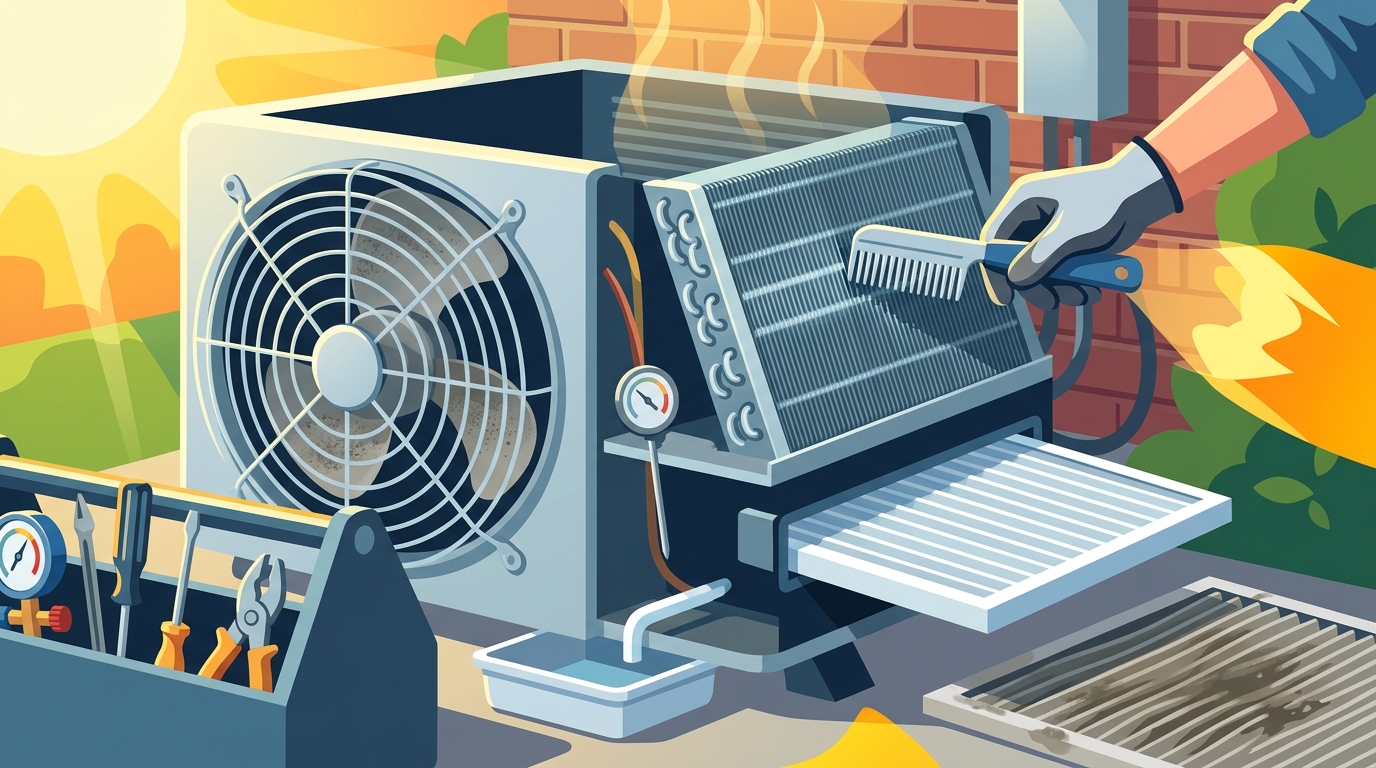
An air filter is a mesh screen that traps dust, pollen, and debris before they enter your HVAC system. A dirty filter is one of the most common causes of AC trouble during summer. When filters get clogged, they restrict airflow, causing the system to overheat and potentially blow warm air.
How Often Should You Change Your Filter?
During heavy summer use, replace disposable filters every 1 to 3 months. Homes with pets or allergy sufferers should change filters monthly. Hold the filter up to a light source; if no light passes through, it needs replacing immediately.
Step 3: Inspect the Outdoor Condenser Unit
A condenser unit is the outdoor component of your AC system that releases absorbed heat into the outside air. If it is covered in leaves, dirt, or debris, it cannot release heat properly.
Quick Condenser Maintenance
- Turn off the system before inspecting.
- Clear away debris, leaves, and vegetation within 2 feet on all sides.
- Gently rinse the coils with a garden hose. Never use a pressure washer.
- Check that the fan spins freely and listen for unusual sounds.
If you notice ice forming on any part of the outdoor unit, turn the system off and contact our emergency repair team right away.
Common Summer AC Problems and Solutions
Below is a quick-reference table of the issues we see most often during Southern California summers:
| Problem | Likely Cause | DIY Fix | Needs a Pro? |
|---|---|---|---|
| AC blowing warm air | Dirty filter, low refrigerant, dirty evaporator | Replace filter, check thermostat | Yes, if filter swap fails |
| AC won't turn on | Tripped breaker, faulty wiring, dead thermostat batteries | Reset breaker, replace batteries | Yes, if it trips again |
| Uneven cooling between rooms | Blocked vents, leaky ductwork, failing blower motor | Open all vents, remove obstructions | Yes, for duct leaks |
| Water leaking from unit | Clogged drain line, frozen evaporator coil | Flush drain with vinegar and water | Yes, if leak persists |
| AC cycles on and off rapidly | Dirty filter, thermostat issue, oversized system | Replace filter, recalibrate thermostat | Yes, for refrigerant or electrical issues |
| Strange noises (buzzing, rattling) | Loose parts, electrical issues, failing compressor | Tighten visible panels | Yes, always for electrical or buzzing sounds |
| Musty or burning smell | Mold in ducts, burning wires | Replace filter for musty smell | Yes, immediately for burning smell |
For persistent issues, schedule an inspection with our Thousand Oaks AC repair or Simi Valley AC repair specialists.
When to Call a Professional HVAC Technician
Some AC problems are too dangerous or complex for DIY fixes. Call a licensed technician immediately if you notice:
- An electrical or burning smell coming from your vents or outdoor unit.
- The circuit breaker trips repeatedly after resetting.
- Ice buildup on the evaporator coils or refrigerant lines.
- Hissing sounds that could indicate a refrigerant leak.
- Your system is more than 12 to 15 years old and losing cooling capacity.
Refrigerant handling requires EPA certification, and electrical repairs carry a risk of shock. At Air Force Air Conditioning & Heating, our NATE-Certified professionals serve Conejo Valley, Simi Valley, Thousand Oaks, Westlake Village, and Ventura County with same-day and emergency HVAC service.
Preventive Maintenance to Avoid Summer Breakdowns
Preventive maintenance is a scheduled service visit where a technician inspects, cleans, and tunes your HVAC system to catch small problems before they become expensive repairs. The Department of Energy recommends hiring qualified technicians for regular maintenance and ensuring refrigerant levels match manufacturer specifications.
What a Tune-Up Includes
- Checking and topping off refrigerant levels
- Cleaning evaporator and condenser coils
- Testing electrical connections and capacitors
- Flushing the condensate drain line
- Calibrating the thermostat
Schedule your pre-summer tune-up through our maintenance and tune-ups page. Homes that receive annual maintenance experience fewer breakdowns and lower energy bills throughout the cooling season.
Key Takeaways
- Always check your thermostat settings and air filter before assuming a major AC failure.
- Dirty filters are the single most common cause of poor cooling performance in summer.
- Keep at least 2 feet of clearance around your outdoor condenser unit for proper airflow.
- Refrigerant leaks, electrical issues, and compressor failures require a licensed professional.
- Annual preventive maintenance significantly reduces the risk of mid-summer breakdowns.
- Most air conditioners last 12 to 15 years; if yours is older, consider a replacement evaluation.
- Air Force Air Conditioning & Heating offers same-day emergency AC repair across Ventura County and Conejo Valley.
Frequently Asked Questions
Why is my AC running but not cooling on a hot day?
The most common reasons are a clogged air filter, low refrigerant levels, or a dirty evaporator coil. Start by replacing the filter and checking that all vents are open. If the problem persists, a technician should inspect for refrigerant leaks or compressor issues.
How often should I change my AC filter in summer?
During peak summer use, change your filter every 1 to 3 months. Homes with pets, smokers, or allergy sufferers should change filters monthly for best results.
What does it mean when my AC is blowing warm air?
Warm air can indicate a dirty filter, low refrigerant, a malfunctioning compressor, or a thermostat set incorrectly. Check the thermostat and filter first. If neither solves the issue, contact a professional.
Is it normal for water to drip from my AC unit?
A small amount of condensation outside the unit is normal on humid days. However, excessive water or indoor leaks usually point to a clogged drain line or frozen evaporator coil that needs professional attention.
Can I add refrigerant to my AC myself?
No. Handling refrigerant requires EPA certification. A licensed HVAC technician must check for leaks before recharging the system. Adding refrigerant to a leaking system wastes money and harms the environment.
How long do air conditioners typically last?
Most residential air conditioners last 12 to 15 years with proper maintenance. If your system needs frequent repairs or uses the now-phased-out R-22 refrigerant, it may be time to explore AC replacement options.
What should I do if my AC keeps tripping the circuit breaker?
First, reset the breaker once. If it trips again, do not keep resetting it. Repeated tripping can indicate faulty wiring, a failing compressor, or an electrical mismatch. Call a licensed technician immediately.
Does Air Force AC & Heating offer emergency AC repair?
Yes. Air Force Air Conditioning & Heating provides emergency HVAC repair service throughout Conejo Valley, Simi Valley, Thousand Oaks, Westlake Village, and surrounding Ventura County communities. Visit our contact page to request service.
Stay Cool This Summer
Do not let a preventable AC breakdown ruin your hottest days. Whether you need a quick filter check or a full system diagnosis, Air Force Air Conditioning & Heating is here to help. Contact us today to schedule your service or request emergency AC repair in Conejo Valley, Simi Valley, Thousand Oaks, or anywhere in Ventura County.