

Hiring the wrong HVAC contractor in California can cost you thousands of dollars, void your equipment warranty, and even create serious safety hazards. The good news is that the state makes it relatively easy to verify a contractor's credentials before you sign anything. A licensed HVAC contractor is a professional who holds a current C-20 classification issued by the Contractors State License Board (CSLB), confirming they have met experience, examination, and insurance requirements. In this guide, we walk you through every step of finding and vetting a qualified HVAC pro in Ventura County, Conejo Valley, and beyond.
Why HVAC Licensing Matters in California
California has one of the strictest contractor licensing systems in the country. Any HVAC project where the total cost of labor and materials exceeds $500 requires a contractor with a valid state license. Operating without one is a misdemeanor offense that can carry fines up to $15,000.
For homeowners, licensing is your first layer of protection. A licensed contractor must carry a $25,000 surety bond, maintain workers' compensation insurance, and pass a criminal background check. These requirements exist to protect you from substandard work, financial loss, and on-the-job injuries that could become your liability.
Unlicensed work often leads to shortcuts that can void manufacturer warranties, reduce energy efficiency, and create fire or carbon-monoxide hazards. If you need AC and heating repair services, always confirm your contractor's credentials first.
What Is a C-20 License?
A C-20 license is California's specialty contractor classification for Warm-Air Heating, Ventilating, and Air-Conditioning work. It is issued by the CSLB and authorizes contractors to fabricate, install, service, repair, and maintain HVAC systems, including ductwork, flues, thermostatic controls, and air filtration equipment.
To qualify for a C-20 license, an applicant must have at least four years of journey-level HVAC experience within the last ten years. They must also pass two state exams: a trade-specific C-20 exam and a Law and Business exam. As of January 1, 2025, the CSLB also requires proof of EPA Section 608 Certification for all C-20 applicants.
All C-20 contractors must carry workers' compensation insurance regardless of whether they have employees. This requirement distinguishes the C-20 from many other specialty classifications and reflects the higher-risk nature of HVAC work.
How to Verify a Contractor's CSLB License
Verifying a license takes just a few minutes and should happen before you sign any contract or pay a deposit. Here is how to do it:
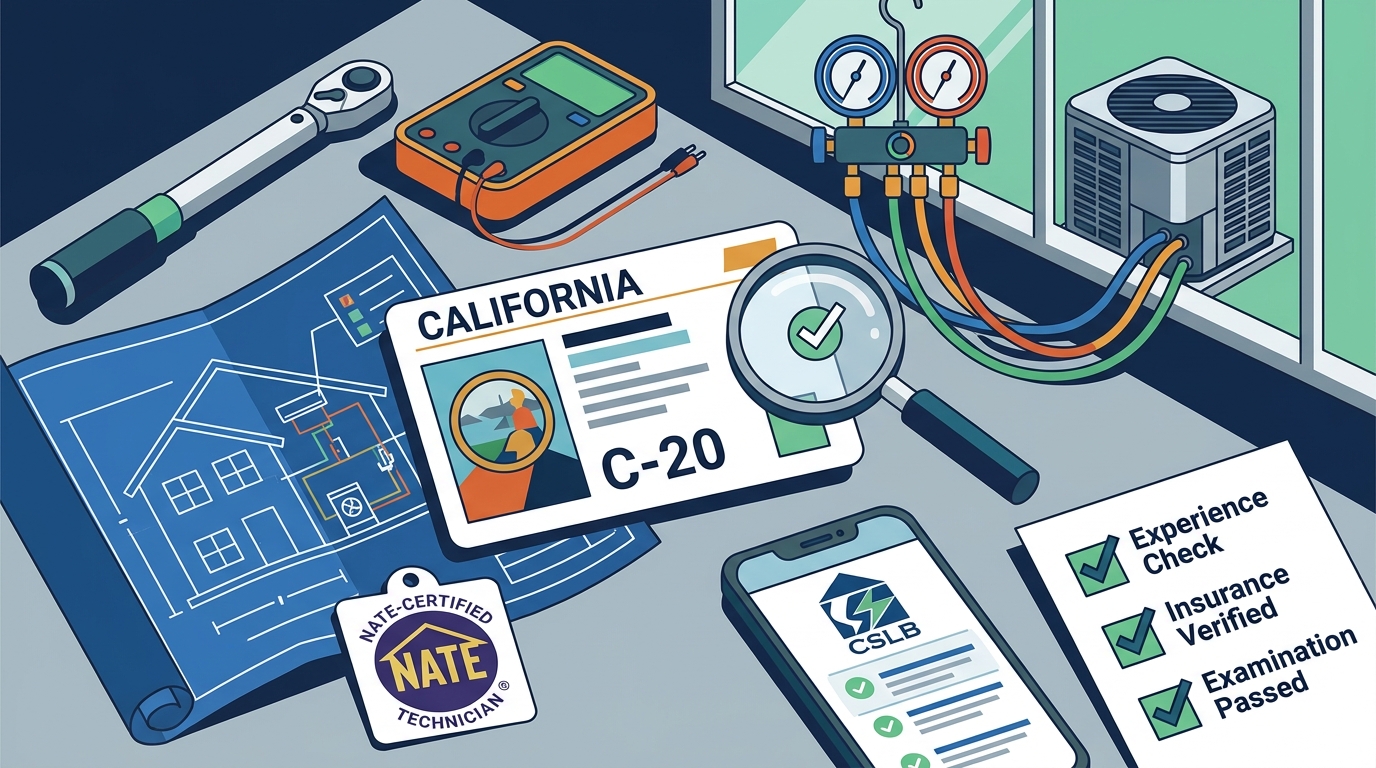
Step 1: Visit the CSLB Website
Go to cslb.ca.gov and navigate to the "Check a License" tool. You can search by license number, business name, or individual name.
Step 2: Review the Results
The lookup displays the license classification, current status (active, inactive, suspended, or revoked), expiration date, bonding status, workers' compensation filing, and any complaint or disciplinary history. Make sure the status shows "Active" and the classification includes C-20.
Step 3: Call for Confirmation
You can also call the CSLB directly at (800) 321-2752. This is especially useful if you want to ask about recent complaints or pending actions that may not yet appear online.
What to Look for Beyond the License
A valid license is the minimum bar. When choosing an HVAC contractor for your Thousand Oaks or Simi Valley home, look for these additional credentials:
- NATE Certification: NATE (North American Technician Excellence) certification is a voluntary, industry-recognized credential that tests technicians on real-world HVAC scenarios. At Air Force Air Conditioning & Heating, every technician on our team is NATE-Certified.
- Insurance verification: Ask for a certificate of insurance that covers both general liability and workers' compensation.
- Local track record: A company that has been serving your area for years understands local building codes and climate demands. Air Force AC & Heating has proudly served homeowners across Ventura, Los Angeles, and Santa Barbara Counties since 2012.
- Written estimates: California law prohibits contractors from asking for a down payment exceeding 10% of the contract price or $1,000, whichever is less.
Licensed vs. Unlicensed Contractors: A Comparison
The table below highlights the key differences between hiring a licensed HVAC contractor and an unlicensed operator.
| Criteria | Licensed C-20 Contractor | Unlicensed Operator |
|---|---|---|
| CSLB License | Active, verifiable online | None |
| Surety Bond | $25,000 minimum | No bond protection |
| Workers' Comp | Mandatory for C-20 | No coverage; homeowner may be liable |
| Warranty Protection | Preserves manufacturer warranties | May void warranties |
| Building Permits | Can pull and close permits | Cannot legally obtain permits |
| Legal Recourse | CSLB complaint process available | Limited legal options |
| Background Check | Fingerprinting required by CSLB | No screening |
If you are planning a new HVAC installation or replacement, working with a licensed contractor ensures your investment is protected from day one.
Questions to Ask Before You Hire
Before scheduling any work, ask prospective contractors these questions:
- What is your CSLB license number, and is it currently active?
- Do you carry both general liability and workers' compensation insurance?
- Are your technicians NATE-Certified?
- Will you pull the necessary building permits for this project?
- Can you provide references from recent jobs in my area?
- What is included in your written estimate, and what is your warranty policy?
Any reputable contractor will answer these questions without hesitation. If a contractor refuses to share their license number or proof of insurance, that is a significant red flag. For emergency HVAC repair, it is especially tempting to skip vetting, but doing so can lead to costly mistakes.
Key Takeaways
- California law requires a C-20 license for any HVAC project exceeding $500 in labor and materials.
- The CSLB's free online "Check a License" tool lets you verify any contractor's status, bond, and complaint history in minutes.
- All C-20 contractors must carry workers' compensation insurance, even if they have no employees.
- Look for additional credentials like NATE certification, which confirms advanced technical competency.
- Never pay more than 10% of the contract price or $1,000 upfront, as required by California law.
- Unlicensed contractors cannot legally pull permits, which means your project may fail inspection.
- A locally established company with verifiable reviews offers the strongest combination of accountability and expertise.
Frequently Asked Questions
What license does an HVAC contractor need in California?
An HVAC contractor in California needs a C-20 Warm-Air Heating, Ventilating, and Air-Conditioning license issued by the Contractors State License Board (CSLB). This license covers installation, repair, maintenance, and fabrication of heating and cooling systems.
How do I check if an HVAC contractor is licensed in California?
Visit the CSLB website at cslb.ca.gov and use the "Check a License" tool. You can search by license number, business name, or the contractor's personal name. The tool shows license status, classification, bond information, and any complaints.
Can I hire an unlicensed HVAC contractor for small jobs?
Technically, California allows unlicensed work only when the total project cost (labor plus materials) is under $500. However, most HVAC repairs and installations exceed that threshold, making a license effectively mandatory for nearly all jobs.
What happens if I hire an unlicensed contractor?
Under California Business and Professions Code Section 7031, an unlicensed contractor cannot enforce a contract or collect payment for work performed. You also lose the protection of the CSLB complaint process, and any work done without permits could create issues when you sell your home.
What is NATE certification, and why does it matter?
NATE certification is a voluntary credential awarded by North American Technician Excellence. It is the leading national certification for HVAC technicians and tests real-world knowledge of installation, service, and repair. Hiring a NATE-certified technician gives you added confidence in the quality of work.
Does a licensed contractor need insurance in California?
Yes. All C-20 licensed contractors must carry workers' compensation insurance on file with the CSLB. General liability insurance is not state-mandated but is strongly recommended and is standard practice among reputable HVAC companies.
How long has Air Force Air Conditioning & Heating been serving Southern California?
Air Force Air Conditioning & Heating was founded in 2012 and has served homeowners and businesses across Ventura, Los Angeles, and Santa Barbara Counties for over a decade. Our team is fully licensed, bonded, insured, and staffed by NATE-Certified technicians.
Ready to Work With a Licensed HVAC Contractor?
Air Force Air Conditioning & Heating brings over a decade of licensed, insured, and NATE-Certified expertise to every project across Conejo Valley, Simi Valley, Thousand Oaks, Westlake Village, and Ventura County. Whether you need a seasonal tune-up or a complete system replacement, we are here to get the job done right the first time. Contact us today to schedule your service.