
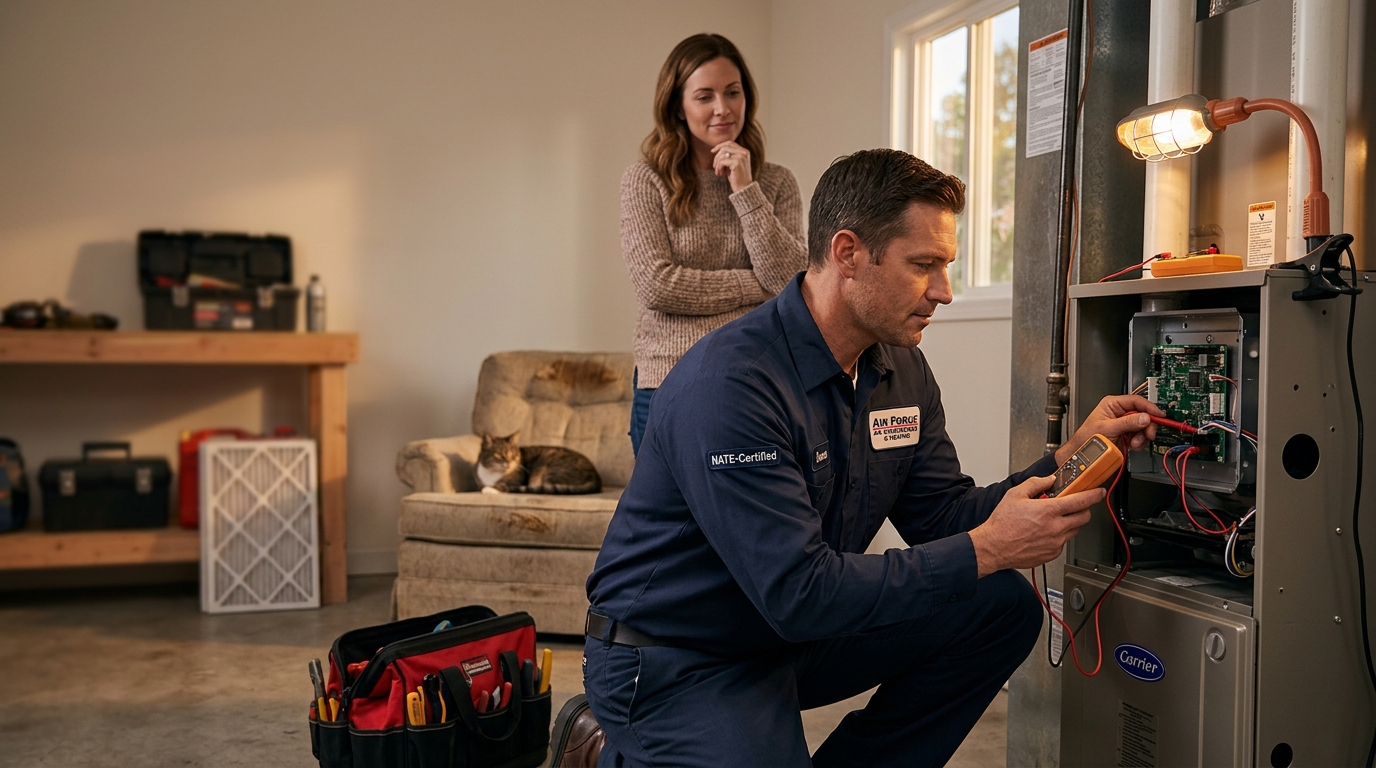
When your heater stops working on a cold Southern California evening, knowing what happens during a professional heating repair visit can save you time, stress, and money. Heating repair is the process of diagnosing and resolving mechanical, electrical, or airflow problems in a home or commercial heating system to restore safe, efficient operation. Whether you live in Conejo Valley, Simi Valley, or Thousand Oaks, understanding each step helps you make informed decisions and communicate clearly with your HVAC technician. Below, Air Force Air Conditioning & Heating breaks down exactly how a heating repair service is carried out from start to finish.
Step 1: Recognize the Warning Signs
Every successful heating repair starts before the technician arrives. Homeowners need to identify symptoms that indicate their system is struggling. Common warning signs include uneven temperatures between rooms, unusual banging or clicking noises, a sudden spike in energy bills, and the system blowing cold air when warm air is expected.
High Energy Bills
A heating system that consumes more energy than usual often has dirty air filters, cracked ductwork, or a failing blower motor. According to the U.S. Department of Energy, neglected HVAC maintenance can increase energy consumption by up to 25%.
Cold Air From Vents
If your furnace runs but delivers cold air, the ignition system, thermocouple, or gas valve may need attention. This is one of the most common reasons homeowners in Ventura County call for heating repair services.
Step 2: Schedule a Professional Inspection
Once you notice a problem, the next step is contacting a licensed HVAC company. A professional inspection is a thorough evaluation of your heating equipment by a certified technician who checks electrical connections, gas lines, airflow, and controls.
When you call Air Force Air Conditioning & Heating, our team gathers key details about your system type, age, and symptoms before dispatching a NATE-certified technician. NATE certification is the industry's most recognized credential, verifying that a technician has passed rigorous testing on HVAC installation, service, and repair, as confirmed by NATE (North American Technician Excellence).
Step 3: System Diagnosis and Testing
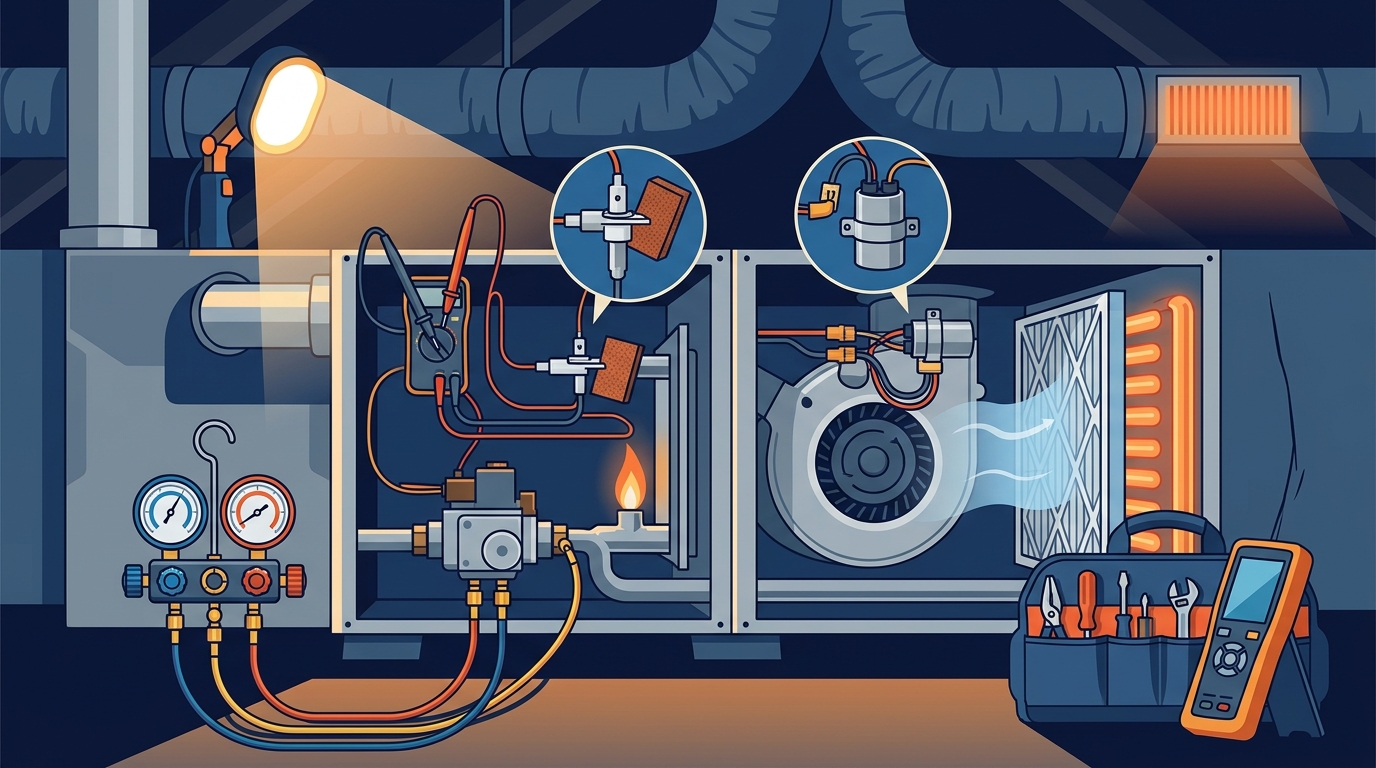
On arrival, the technician performs a multi-point inspection. This typically includes checking the thermostat calibration, inspecting the heat exchanger for cracks, testing ignition components, measuring airflow across the supply and return vents, and evaluating electrical connections.
Common Diagnostic Tools
Technicians use combustion analyzers, manometers, and multimeters to pinpoint problems accurately. Proper diagnosis prevents unnecessary part replacements and keeps your repair costs down.
What Homeowners Can Do First
Before the technician arrives, check your thermostat settings, replace the air filter if it is visibly dirty, and make sure all vents are open. These simple steps can sometimes restore operation and always speed up the diagnostic process.
Step 4: Execute the Repair
After identifying the root cause, the technician explains the issue and provides a transparent cost estimate. Common heating repairs include replacing a faulty igniter, repairing a cracked heat exchanger, fixing thermostat wiring, cleaning burner assemblies, and sealing leaky ductwork.
| Common Heating Problem | Typical Cause | Average Repair Time |
|---|---|---|
| No heat output | Failed igniter or pilot light | 30 - 60 minutes |
| Short cycling | Dirty flame sensor or overheating | 30 - 45 minutes |
| Weak airflow | Clogged filter or blower issue | 20 - 40 minutes |
| Strange noises | Loose components or worn bearings | 30 - 60 minutes |
| High energy bills | Duct leaks or inefficient burner | 1 - 2 hours |
Our technicians serving Thousand Oaks and Simi Valley carry common replacement parts on their service vehicles, which means most repairs are completed in a single visit.
Step 5: Verify Performance and Safety
Once the repair is complete, a responsible technician does not simply leave. The system is cycled on and off multiple times while the technician monitors temperature output, checks for gas leaks using electronic detectors, and confirms that the unit meets manufacturer specifications.
Safety verification is especially important for gas furnaces. The Consumer Product Safety Commission (CPSC) reports that faulty heating equipment is a leading source of residential carbon monoxide exposure. A properly tested system protects your household from this invisible hazard.
Step 6: Set Up Preventive Maintenance
The final step extends the life of your repair investment. Preventive maintenance is a scheduled service plan that includes filter changes, coil cleaning, electrical testing, and system calibration performed at regular intervals. The Air Conditioning Contractors of America (ACCA) recommends servicing heating systems at least once per year, ideally before the cooler months.
Air Force Air Conditioning & Heating offers comprehensive maintenance and tune-up plans designed to catch small issues before they become costly breakdowns. Regular maintenance can extend a furnace's lifespan from the typical 15-20 years even further.
Repair vs. Replacement: When Each Makes Sense
Not every heating problem warrants a repair. If your system is over 15 years old, requires frequent service calls, or the repair cost exceeds 50% of a new unit's price, replacement may be the smarter financial decision. Visit our installation and replacement page to explore your options.
For urgent situations where the system fails unexpectedly, our emergency repair services are available to restore comfort quickly across Ventura, Los Angeles, and Santa Barbara Counties.
Key Takeaways
- Heating repair follows a structured process: identify symptoms, schedule an inspection, diagnose, repair, verify, and maintain.
- Common warning signs include cold air from vents, unusual noises, short cycling, and rising energy bills.
- NATE-certified technicians use specialized tools like combustion analyzers and manometers for accurate diagnosis.
- Most residential heating repairs in Southern California can be completed in a single service visit.
- Post-repair safety testing for gas leaks and carbon monoxide is a non-negotiable step.
- Annual preventive maintenance reduces breakdowns and extends equipment lifespan by years.
- If repair costs exceed 50% of a new system's price, replacement is often the better investment.
Frequently Asked Questions
How long does a typical heating repair take?
Most standard heating repairs take between 30 minutes and 2 hours, depending on the complexity of the issue. Simple fixes like replacing an igniter are faster, while duct sealing or heat exchanger work takes longer.
How much does heating repair cost in the Conejo Valley area?
Heating repair costs in the Conejo Valley typically range from $150 to $600 for common issues. Major component replacements like a heat exchanger can cost more. Air Force Air Conditioning & Heating provides upfront estimates before any work begins.
How do I know if I need repair or full system replacement?
If your heater is under 15 years old and the repair is a one-time fix, repair usually makes sense. If the system needs frequent repairs or the cost exceeds half the price of a new unit, consider replacement.
Can I do any heating troubleshooting myself before calling a technician?
Yes. Check your thermostat settings, replace a dirty air filter, and make sure supply and return vents are not blocked. These basic checks resolve some issues without a service call.
What types of heating systems do you repair?
Air Force Air Conditioning & Heating repairs gas furnaces, heat pumps, ductless mini-splits, wall heaters, and packaged HVAC units across Thousand Oaks, Simi Valley, Westlake Village, and surrounding areas.
Is heating repair covered under warranty?
Many manufacturers offer 5- to 10-year parts warranties on heating equipment. Labor warranties vary by installer. Our team checks your warranty status during every service visit and applies applicable coverage.
Do you offer emergency heating repair?
Yes. Our team provides emergency heating repair for homes and businesses throughout Ventura County and the San Fernando Valley. Call us anytime your heater fails unexpectedly.
How often should I schedule heating maintenance?
Schedule professional heating maintenance at least once a year, ideally in early fall before temperatures drop. Annual tune-ups improve efficiency and help prevent mid-season breakdowns.
Get Your Heater Fixed Today
Do not wait for a small heating issue to turn into a major breakdown. Whether you need a quick repair or a full system evaluation, Air Force Air Conditioning & Heating is ready to help homeowners across Conejo Valley, Simi Valley, Thousand Oaks, and Westlake Village. Contact us today to schedule your heating repair with a NATE-certified technician.